
Tag

Estate Planning

Guardianship vs. POA: Exploitation

By Elder Law, Estate Planning, Guardianship

While appointing a power of attorney can mitigate the need for a guardianship, there are other times in which a guardianship is necessary.

In the last blog post, we discussed the need for a guardianship in the event that the incapacitated person lacks competency and makes harmful decisions. A guardianship may also be needed if the power of attorney does not act in the best interest of the incapacitated person.  If the power of attorney is exploiting the individual by depriving them of their funds or their rights, a court will appoint a guardian to prevent any continued abuse.

If you have more questions on this topic, please contact our office at (941) 906-1231 to speak with one of our attorneys.

Guardianship vs. POA: Incapacitated Individuals

By Elder Law, Estate Planning, Guardianship

In estate planning documents, an agent can be  chosen to act under a power of attorney, which is especially  useful in the event that the principal becomes incapacitated and cannot make decisions for himself.  Typically, a power of attorney is given the authority to control financial affairs. Other times, powers of attorney have complete control over the ward.

When the power of attorney is properly advocating for the ward, and the ward is cooperative, a guardianship may be avoided. However, there are instances and situations that nonetheless necessitate a guardianship. If the incapacitated individual continues undertaking financial activities that put their assets at unreasonable risk of depletion and wasting, a guardianship may be necessary. The guardian can make decisions regarding the ward’s financial, legal, and medical affairs, but some decisions must be approved by the court. By appointing a guardian, the court is able to preserve the ward’s property from dissipation.

If you have more questions on this topic or wish to set up documents, please contact our office at (941) 906-1231 to speak with one of our attorneys.

How to Prevent Property from Getting Lost and “Unclaimed”

By Asset Protection Planning, Estate Planning

In the last few blogs, we discussed the process of finding and claiming lost property. However, there are safeguards and steps to follow in order to prevent your property from getting lost.

Because property goes unclaimed due to the absence of communication between the financial institution and the owner of the account, you should contact the institutions each year and notify them of any changes to your address, financial matters, or marital status.

It is also imperative to maintain detailed and accurate financial records. These records should also include records of bank account numbers, types of accounts, insurance policies, and stock certificates.

After receiving checks such as for wages, dividends, and insurance settlements, make sure to cash them without delay. Also, if you have a safe deposit box, record its number, bank name, and provide the extra key to a person you trust.

Lastly, you should prepare a Last Will and Testament that sets up the distribution of your assets. To create or update these documents, contact our office at (941) 906-1231 to schedule an appointment with one of our attorneys.

Claiming Lost Property in Florida

By Asset Protection Planning, Estate Planning

To claim lost property, go to your state’s unclaimed property administrator’s office. There you will find the proper instructions and forms. If you are a Florida resident, go to https://www.fltreasurehunt.org/.

The claim forms may require certain documentation such as a copy of current identification and proof that you are the owner of the account. The Florida Department of Financial Services may take up to 90 days to make a determination about the claim.

If you are a guardian or acting as an agent for someone under a durable power of attorney, you can complete a search on behalf of the individual for whom you advocate, if you are authorized to do so.  To claim the property as a guardian, you may be required to provide a copy of the documents appointing you as guardian or power of attorney to ensure you actually have the authority to do so.

And for executors of an estate or personal representatives, you should also search for any unclaimed property of the deceased individual. Unlike the process for guardians and agents, the search process may be more difficult for executors and personal representatives due to the documents that you must produce. However, Bach & Jacobs, P.A. represent and assist executors and personal representatives in the administration of estates, including ancillary administration, and can guide you through the process.

Babette Bach Esq. Will Be a Guest Speaker at Event on March 31st, 2017

By Firm News, Health

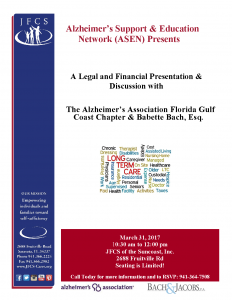
Attorney Babette Bach, Esq. will be a keynote speaker at an event at JFCS of the Suncoast entitled “A Legal & Financial Presentation & Discussion with The Alzheimer’s Association & Babette Bach, Esq”. This event will take place on March 31st, 2017 from 10:30am to 12:00pm and is presented by the Alzheimer’s Support & Education Network. Please see the event flyer and call 941-364-7508 for more information.

caregiver-education-march-2017


How do I find unclaimed property?

By Asset Protection Planning, Estate Planning

Companies and financial institutions are required under law to returns the money from abandoned accounts to the state of the owner’s last address.

To find missing funds, you could begin your search at http://www.missingmoney.com/ which is endorsed by the National Association of Property Administrators. Some companies and institutions also assist you in finding your property for a percentage of the value they help recover.

However, some of these offers are not always legitimate. In Florida, the state’s unclaimed property administrator gives a free online search at to https://www.fltreasurehunt.org/. Contact our office at (941) 906-1231 meet with an attorney regarding the transfer of your deceased loved one’s assets and to ensure that your lost property search is conducted properly.

What to Know About Having Witnesses Present at Your Will Signing

By Estate Planning

When you create a Will, you must obtain signatures from at least two witnesses at the time you sign it for it to be considered valid. The purpose of having two witnesses is so that, if the validity of your Will is ever challenged, they can both attest to your state of mind. These witnesses do not have to read your Will or even be aware of its contents, they just have to be able to certify that you were competent when you signed it. If you are working with an attorney, they should make you aware of this information and help explain the process of having a document witnessed. However, it is good to know some general information regarding rules for witnessing so that you feel more prepared when the time comes to make your Will official or update it.

If you would like to choose your own witnesses, be careful who you pick. Select individuals that are credible and will likely live longer than you, in case they are later asked to testify about the validity of your Will. If possible, avoid having beneficiaries of your Will also be witnesses, as this could be considered a conflict of interest. However, having a beneficiary or interested person witness the Will does not automatically invalidate the Will. If you would rather not choose witnesses, the attorney that you have been working with will likely have paralegals or legal assistants on-hand that can serve as credible witnesses. This eliminates the added stress of having to choose your own witnesses and bring them to the signing. At Bach & Jacobs, members of our team generally serve as witnesses during Will and trust signings.

Make sure you have the right number of witnesses, as every state requires that you have two individuals sign your Will in order for it to be legally binding. Additionally, these witnesses must sign your Will in front of you. Generally, your witnesses will sign the Will immediately after you do.

What is unclaimed property?

By Asset Protection Planning, Estate Planning

Unclaimed properties are the assets in accounts that have remained inactive for more than a year. This unclaimed property includes assets in checking and savings accounts, stocks, dividends, trust distributions and more.

The financial institutions where these accounts are located are required under state law to return these accounts to the state’s unclaimed property administrator. In Florida, if the rightful owner never makes a claim for the assets being held by the administrator, then the unclaimed property goes into the State School Fund for public education. The process of claiming property is simple and at no cost.

Assisting in the search for unclaimed property is part of the services that Bach & Jacobs, P.A. provide to personal representatives, trustees, and families of those who have passed away. Bach & Jacobs is a full services probate and trust firm that can assist you in recovering any unclaimed assets titled in the name of your deceased loved one.

Estate Planning Documents Everyone Needs To Have

By Estate Planning

Attorney Babette Bach Esq. is looking forward to speaking on the topic of “Estate Planning Documents Everyone Needs To Have” at The Glenridge on Palmer Ranch, 7333 Scotland Way, Sarasota, FL 34238 on Thursday, January 26th, 2017 at 1pm. Please call Dr. Smith at The Glenridge on 941-552-5369 for more information on this event.

If you have further questions on this topic or wish to discuss having your estate planning documents drafted, please contact our office at (941) 906-1231 to schedule an appointment to meet with one of our attorneys.