Dementia is a disorder of the mental processes that is caused by brain disease or injury and is linked to memory problems, personality changes and impaired reasoning. Since individuals are living longer than they did in the past, our population of elderly people is increasing. This has created the belief in many that the rates of dementia would start to rise significantly. However, studies suggest that Dementia rates in the United States and around the world are decreasing. An observational study posted by the Jama Internal Medicine Network of more than 21,000 Americans age 65 or older found that dementia rates have fallen by 24% in the last 12 years. Other studies have also found that individuals who do get dementia are starting to get it at older ages. Though the exact reasons for this decline have not been determined as of yet, scientists and researchers across the nation have agreed that this is very positive news and are working to discover what factors could be causing this significant drop.
Alzheimer’s disease is a sadly prevalent illness that most commonly affects senior citizens. It destroys brain tissues and causes memory changes as well as erratic behavior and loss of body functions. Though Alzheimer’s can progress slowly and have limited symptomatic effects when first diagnosed, it is a terminal illness. Alzheimer’s is the sixth leading cause of death in the United States and is among the top 10 diseases in the nation that cannot be reversed or cured. The Alzheimer’s epidemic is greater than ever, as more than 5 million people in the U.S. have this disease. Additionally, deaths resulting from Alzheimer’s disease have increased by 68% between 2000 and 2010. As Alzheimer’s progresses, an individual loses their memory as well as their mental and physical function. It is the loss of these functions that ultimately leads to death. Although Alzheimer’s cannot be cured and is fatal, there are treatments available to delay its symptoms and improve the quality of life of Alzheimer’s patients.
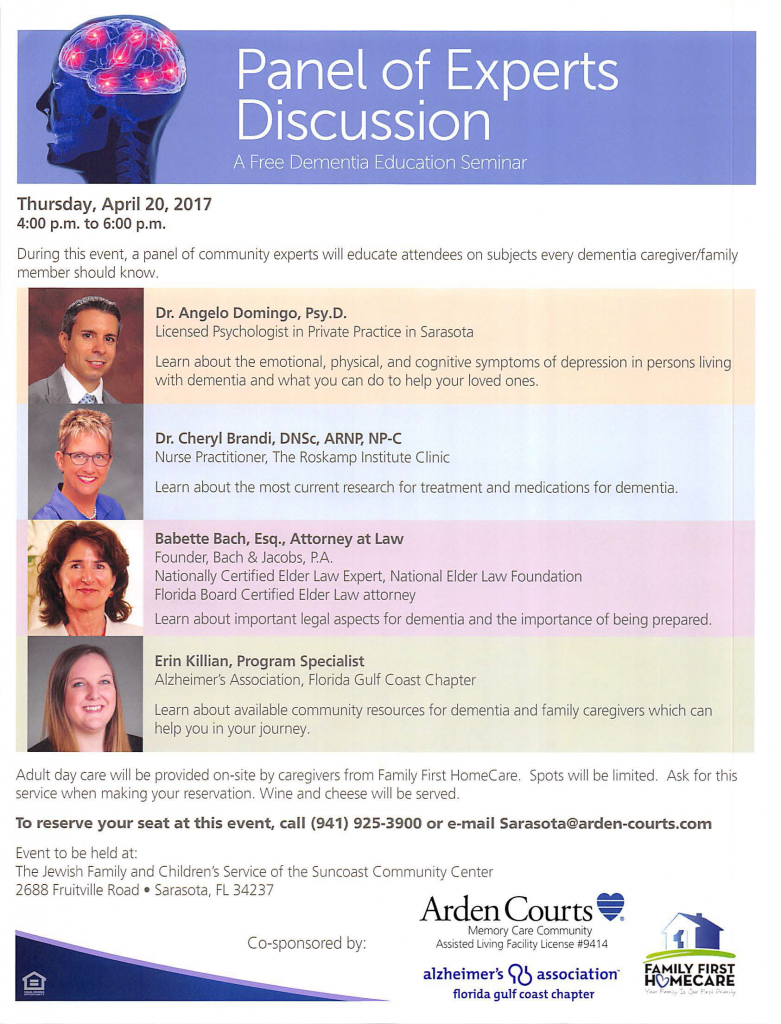
Attorney Babette Bach, Esq. will be a speaker at the “Panel of Experts Discussion – A Free Dementia Education Seminar” at The Jewish Family and Children’s Service of the Suncoast Community Center. This event will take place on April 20th, 2017 from 4pm to 6pms. Please see the event flyer for more information should you wish to attend.
Disaster preparedness is important for everyone, but especially for those who reside in Florida and experience the hurricane season. For seniors, it is imperative that they create plans with family members and know who to contact during times of emergency.
A good first step is to discuss the risks in the area where you reside. Depending on your location, it may be necessary to make multiple plans for different emergency situations.
Make arrangements with family, friends, and neighbors before an emergency. Make sure to exchange important keys, phone numbers, and addresses. Also, share copies of emergency documents, evacuation plans, and health information.
For families offering assistance to their elderly loved ones, show them where their emergency supplies are located. In addition to showing them, periodically check with them to see if they remember the location. Your supplies should include items like water, nonperishable food, important medications, extra glasses, hearing aids, and batteries. It is also a good idea to store documents and information on a flash drive to have access to digital copies.
See the attached form from the Federal Emergency Management Agency to fill out a family plan: https://www.ready.gov/sites/default/files/documents/files/Family_Emegency_Plan.pdf. The form includes spaces to fill out relevant phone numbers, insurance information, and social security information.
Attorney Babette Bach, Esq. will be a keynote speaker at an event at JFCS of the Suncoast entitled “A Legal & Financial Presentation & Discussion with The Alzheimer’s Association & Babette Bach, Esq”. This event will take place on March 31st, 2017 from 10:30am to 12:00pm and is presented by the Alzheimer’s Support & Education Network. Please see the event flyer and call 941-364-7508 for more information.
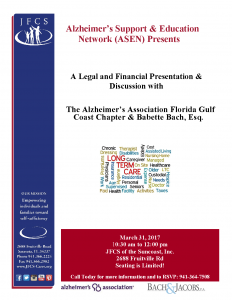
caregiver-education-march-2017
According to an NPR article titled “A Sniff Test for Alzheimer’s Checks For The Ability to Identify Odors,” it may become more common for doctors to utilize a sniff test to screen people for Alzheimer’s disease. The test assesses people’s ability to identify odors like chocolate and coffee.
At the Alzheimer’s Association International Conference in Toronto, a team of scientists presented their findings; the majority of 60- and 70-year-old individuals in the group who performed poorly identifying the smells later went on to experience cognitive and memory problems.
This odor test, called the University of Pennsylvania Smell Identification Test, presents many benefits for the medical and Alzheimer’s communities. The article implies that although the tests are not perfect at predicting the disease, they are inexpensive and easy to use. Currently, most tests that are used to identify early stages of Alzheimer’s are reportedly much more expensive. Examples of these tests include PET scans and spinal taps.
Read the original article here: http://www.npr.org/sections/health-shots/2016/07/26/487391863/a-sniff-test-for-alzheimers-checks-for-the-ability-to-identify-odors.
In November, the Florida Medical Marijuana Legalization Initiative, also known as Amendment 2, will be on the ballot again after its defeat in 2014. The amendment has been surrounded by controversy with people on both sides advocating for its success and defeat. Supporters claim the passing of this amendment could help treat problems like chronic pain, glaucoma, cancer, PTSD, Parkinson’s disease, multiple sclerosis and more, which is an interest to many elderly people in Florida.
If the amendment passed, medical marijuana would be legal for individuals with specific diseases or individuals with conditions that are debilitating, AS determined by a physician. The amendment also has provisions that would require the Florida Department of Health to oversee marijuana production and distribution centers. In addition the Department of Health would also issue identification cards for patients and caregivers.
The amendment would provide about 450,000 Florida residents with access to full-strength cannabis.
In order for Amendment 2 to pass it would need a 60% supermajority. In 2014, the amendment received 57.62% of approval from Florida residents, and was just shy of receiving the supermajority.
Read more about the amendment here: https://ballotpedia.org/Florida_Right_to_Medical_Marijuana_Initiative,_Amendment_2_(2016)
Leon County and the City of Tallahassee are the first Dementia Caring Community in Florida, under a new designation in April 2016 by Sam Verghese, Secretary of the Florida Department of Elder Affairs.
According to Verghese, the initiative stems from the fact that Florida has the second highest incidence of Alzheimer’s disease in the United States. The community is part of the Department’s Dementia Care and Cure Initiative and will support individuals and families affected by the disease.
The department and city are currently in the process of creating a community work plan to take action at a local level. The city will work to achieve several goals for the Alzheimer’s and Dementia community through “awareness, assistance, and advocacy,” according to Verghese.
This announcement also comes with the news that the governor appointed four people to the Alzheimer’s Disease Advisory Committee. Three of the appointees will serve three-year terms and one will serve a two-year term.
The Palm Beach County Commission recently funded a pilot program that assists individuals and families affected by Alzheimer’s disease. The commission on June 21, 2016 approved a $20,000-plus contract to provide 100 Alzheimer’s patients with electronic ID locator bracelets.
Due to Alzheimer’s disease, many senior citizens with the disease tend to forget basic personal information, wander off, and become disoriented. The ID bracelets aim to combat these dangerous situations by allowing law enforcement to quickly find a patient’s location by land or air.
The commission also accepted a contract with Gulfstream Goodwill Industries worth up to $40,000 to grant hearing aids and other interpreting services to senior citizens.
In a bipartisan effort, the Senate Appropriations Committee has proposed a plan to increase funding for Alzheimer’s research at the National Institutes of Health by $400 million.
Currently, funding for Alzheimer’s research is at $991 million, and the $400 million boost would put the Alzheimer’s Association more than halfway toward its goal of receiving $2 billion per year in funding.
The bipartisan push was led by Republican and Chairman Roy Blunt and Democratic Ranking Member Patty Murray, who were also involved in last year’s funding increase.