Tag

Elder Law

Care Planning Part 2

By Long-Term Care

While typical estate planning includes planning for incapacity during one’s lifetime as well as distribution of one’s assets upon their passing, Elder Law attorneys have an added focus of planning with long-term care in mind. If and when long term care becomes necessary, your end of life planning documents allow those you trust most to ensure you are cared for in a manner that comports with your wishes. Adding certain provisions to existing planning documents can enable those trusted persons to pursue additional planning strategies if and when the time comes for a senior to utilize long-term care. When the time comes for Medicaid pension planning, it is critical that the agent have the authority to take specific actions on behalf of the elderly person, such as establishing and funding an irrevocable trust, filing a Medicaid application, or preparing a VA pension application. The grant of authority must be clearly stated within the documents. Having clients in our office before they are in need of immediate long-term care allows our attorneys to successfully assist our clients in the most effective manner possible.

If you have further questions, contact our office at (941) 906-1231 to schedule an appointment with one of our attorneys.


Long term care planning series: Planning Before a Crisis

By Long-Term Care

The best long term care options are available through early planning. We care a great deal for our clients and try to help make transitions as seamless as possible for them. We recommend planning prior to these issues, so that when difficult issues arise things go as smoothly as possible. Typical estate planning involves the distribution of a person’s assets after they pass away. Here at Bach and Jacobs we have additional focus on end of life planning and encourage you to contact us to review your plans before crisis hits. However, we will also help you navigate emergency senior care issues as well. Because we want to help you plan for all of life’s possibilities and protect you and your investments, we include irrevocable trusts that are designed specifically for that purpose.

If you have further questions, contact our office at: 941- 906-1231 to schedule an appointment with one of our attorneys.

 

Medicare vs. Medicaid: What are you eligible for?

By Medicaid Planning, Medicare

Medicare is a federally funded program for which most U.S. citizens and permanent legal residents over the age of 65 who have lived in the country for over five years are eligible for. Medicaid, among other things, supports individuals and families by covering costs associated with both medical and long-term custodial care for those who qualify. Eligibility for Medicaid is means-based, and the program has strict asset and income eligibility requirements that vary from state to state. For more information on current qualification requirements, individuals should visit Medicaid.gov. Additionally, Babette Bach is a Board Certified Elder Lawyer and can assist you with your questions about public benefits and qualifications for Medicaid.

Understanding the Parts of Medicare: Medicare Part D

By Medicare

Medicare part D provides outpatient prescription drug coverage. This part of Medicare is optional and is offered through private companies, which are certified by centers for Medicare/Medicaid services each year. If you want Medicare Part D coverage, you can either apply for a stand-alone plan or, if you have Medicare Part C coverage, you can get your Part D coverage through a Medicare Advantage Plan. Medicare.gov has an excellent program to assist you in choosing the best plan given your geographic location and your current prescriptions.


Understanding the Parts of Medicare: Medicare Part B

By Medicare

Medicare Part B is your Medical Insurance, and it covers two types of services: medically necessary services and preventative services. Medically necessary services include services or supplies that are needed to diagnose or treat your medical condition, such as doctor’s office visits, lab work, outpatient surgeries and x-rays. Preventative services are designed to keep you healthy, and include things such as cancer screenings or flu shots. Medicare Part B also covers medically necessary durable equipment, such as wheelchairs or walkers. Most individuals are required to pay a premium for this type of coverage. This is “Traditional” Medicare and you get to choose any provider you wish who accepts Medicare.

Losing Capacity

By Asset Protection Planning, Estate Planning, Guardianship

It is important that while competent you decide who will make personal decisions and who will make financial decisions on your behalf should you lose capacity. Consulting with an attorney regarding your choice of agent or fiduciary will help ensure that your wishes are followed. If a person has not made these decisions and consulted with an attorney, a legal guardianship proceeding may be commenced to appoint an individual who will make decisions on a person’s behalf if the person is incapacitated.

For help regarding these matters, contact our office at (941) 906-1231 to schedule an appointment with one of our attorneys.

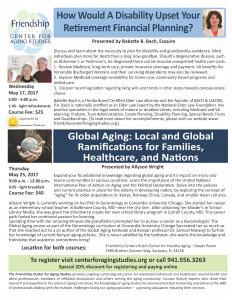
Babette Bach to speak at the Friendship Center on: “How Would A Disability Upset Your Retirement Financial Planning?”

By Asset Protection Planning, Firm News

Babette Bach will be speaking at the Friendship Center, 1888 Brother Geenen Way, event at 2:00pm on Wednesday, May 17th, 2017.  The topic is “How Would A Disability Upset Your Retirement Financial Planning?”. In this hour long program Babette will discuss the necessity to plan for disability and guardianship avoidance. Additionally, she will discuss recent legislation regarding living wills and trends in other states towards compassion choice. For more information on this event, please go to: www.friendshipcenterforagingstudies.org. and click the following link to see the flyer for this event: fcas-may-2017-bach-wright

The benefits of entering into a caregiver agreement

By Guardianship, Long-Term Care

Many seniors have caregivers who provide their skills and care on a daily basis. Whether the caregiver is a family member, friend, or professional, it is a good idea to create a caregiver agreement.

A caregiver agreement should include the services and hours that the caregiver is expected to provide, the needs and wishes of the senior, and compensation for the work. It should also include in writing the frequency of services, the location where services are to be provided, and important dates such as when the care begins and how long the agreement is to be in effect.

The advantages of setting up a caregiver agreement are manifold:

  • It can reduce or avoid Medicaid penalties
  • It prevents confusion with private duty domestic service workers and/or family members and sets up a clear method of compensation so there is no misunderstanding
  • It recognizes the time and effort of those taking care of you
  • It offers security and peace of mind
  • It makes expectations clear


If you are employing caregivers, companions, or other domestic service workers, contact an attorney at Bach & Jacobs, P.A. to discuss how you can help minimize risk and liability by creating a caregiving agreement. This is especially necessary if you are employing private duty caregivers directly rather than through an agency.


Duties of an Agent under a Power of Attorney

By Elder Law, Estate Planning

An agent, or “attorney-in-fact,” is authorized under a power of attorney document to make decisions and undertake financial and business transactions for the person executing the power of attorney (the “principal”). An agent can fill a role and perform certain tasks authorized by the power of attorney.

An important step in fulfilling your role as agent is to follow the instructions in the power of attorney document. It is imperative that in every decision you make for the principal, whether it be medical or financial, it is in the principal’s best interest. It is a good idea to keep a detailed record of your transactions undertaken on behalf of the principal. Depending on the restrictions specified in the power of attorney, the agent typically has the authority to control the principal’s financial affairs. These authorities could include cashing checks, opening and closing bank accounts, paying bills, entering into contacts, etc.

Some principals choose to include specific authorities in their power of attorney documents. The agent can only make these actions if the document specifically authorizes them. Some examples of these powers include making a gift; changing a beneficiary designation; creating, amending or revoking an inter vivos trust; and disclaiming property.

To discuss the creation of a power of attorney as part of your estate planning or if you are an agent appointed under a power of attorney, consult with an attorney at Bach & Jacobs, P.A. that can advise you of your rights and obligations.