
Tag

Estate planning attorney Sarasota

What is a Special Needs Trust?

By Estate Planning

Do you have a loved one who is disabled or has special needs? If so, then a special needs trust (also known as a supplemental needs trust) may be the right option for you and your family. A special needs trust provides your disabled loved one with financial support and is designed to supplement the benefits that a disabled person may receive from government programs. A special needs trust is used so that an individual can still qualify for and receive medical benefits and supplemental security income, without the assets in the trust being calculated as a part of their income when it comes to determining eligibility for benefits from government programs.

If you have further inquiries regarding this matter, please contact our office at: 941-906-1231 to schedule an appointment with one of our attorneys.

Estate Planning for a Vacation Home

By Estate Planning

When you are going about Estate Planning, deciding what to do with a vacation home can seem daunting. If you decide to leave it to one (or more) of your family members, it is important that you discuss this with them. There are several choices you can consider when deciding what to do with your vacation home. If you choose an outright transfer, your home will be given to one (or several) of your loved ones as a gift, but there may be adverse tax consequences of doing so.  Another option would be to place your home in an LLC made up of your family members. If you choose this method, you could have a family member manage the property and allow one or more of your family members to utilize it. You could also transfer your vacation home to a QPRT (Qualified Personal Residence Trust), in which you transfer your home to a family member in exchange for continual rent-free use for a specified term. This is a popular choice because it can reduce the amount of a gift or estate tax.  Another option is gifting your home to an irrevocable trust, which would have rules regarding the use and expenses of the home among the beneficiaries.

Estate Planning comes with a large variety of options and complications. Please contact our office at: 941-906-1231 if you need assistance with your Estate Planning or have questions.

What is a QPRT?

By Estate Planning, Real Estate

A Qualified Personal Residence Trust (QPRT) is a lifetime transfer of a personal residence in exchange for rent-free use of said residence during the trust term. When that term comes to an end, the home passes to the intended beneficiary or beneficiaries. If you are still living at the end of the specified term, you have the option to have the home distributed amongst your loved ones or put into a trust for them. This is a popular estate planning method for individuals that want to give their vacation homes to family members when they pass away because it can reduce the gift or estate tax cost that comes with transferring a residence. Both residence and vacation homes can qualify as QPRTS and often more than one home can be protected.

If you think that a Qualified Personal Residence Trust may be the right choice for you, or need assistance with any Estate Planning matters, contact our office at 941- 906-1231 to schedule an appointment with one of our attorneys.
The Difference Between a Living Will and a DNR

By Estate Planning

To ensure that your end-of-life wishes are carried out in a manner that comports with your wishes, it is important to understand the difference between a Living Will and a DNR (Do Not Resuscitate Order).


A DNR is a medical document that must be signed by both you and your physician in order to be considered valid and in effect. This document asserts that you do not want to be resuscitated if you die, and one can be obtained at your physician’s office. Additionally, a DNR tells the medical staff that is responsible for treating you, should your heart or lungs give out, not to perform CPR or implement a breathing tube. The original copy of this document must be visible to the EMTs to stop them from trying to resuscitate you. Most individuals that choose to have DNRs are those suffering from long-term illnesses or that are very old and want to maintain their dignity in death.


A Living Will is a legal document that details an individual’s end of life desires in regard to their medical treatment if they become incapacitated or unable to express informed consent. A Living Will is implemented so that you are still able to make important health care decisions, such as whether you want to be kept alive via life support, in the event that you are unable to communicate those wishes yourself.


A Living Will and a DNR serve different purposes and can ensure that your wishes are expressed in the most clear and concise manner possible. For help regarding these matters, contact our office at 941- 906-1231 to schedule an appointment with one of our attorneys.
Estate Planning Series: What Is Estate Planning and Why Is It Important?

By Estate Planning

The term Estate Planning refers to the act of preparing for the transfer of a person’s wealth and assets after they pass away. Your “estate” consists of all of the property you owned at your time of death, including but not limited to: real estate, bank accounts, stocks, life insurance policies and personal property. Estate planning is essential because it prevents your assets from ending up with unintended beneficiaries, protects your family and can minimize the amount of taxes that need to be paid for your beneficiaries to receive your property. Additionally, Estate Planning establishes what kind of funeral arrangements that you want, states what kind of life-prolonging medical support you wish to receive if incapacitated and avoids the time as well as the costs associated with probate proceedings. Estate Planning is a way to ensure that your wishes for your assets are honored after you pass away, and can greatly reduce the amount of stress and uncertainty your loved ones will be faced with when you die. Grieving is difficult enough without having to handle a myriad of complex decisions, and Estate Planning can help your family minimize their stress in difficult times such as these.

The skilled attorneys at Bach & Jacobs are experienced in Estate Planning, so if you need assistance or have any questions, please contact our office at (941) -906-1231.

Care Planning Part 2

By Long-Term Care

While typical estate planning includes planning for incapacity during one’s lifetime as well as distribution of one’s assets upon their passing, Elder Law attorneys have an added focus of planning with long-term care in mind. If and when long term care becomes necessary, your end of life planning documents allow those you trust most to ensure you are cared for in a manner that comports with your wishes. Adding certain provisions to existing planning documents can enable those trusted persons to pursue additional planning strategies if and when the time comes for a senior to utilize long-term care. When the time comes for Medicaid pension planning, it is critical that the agent have the authority to take specific actions on behalf of the elderly person, such as establishing and funding an irrevocable trust, filing a Medicaid application, or preparing a VA pension application. The grant of authority must be clearly stated within the documents. Having clients in our office before they are in need of immediate long-term care allows our attorneys to successfully assist our clients in the most effective manner possible.

If you have further questions, contact our office at (941) 906-1231 to schedule an appointment with one of our attorneys.

Losing Capacity

By Asset Protection Planning, Estate Planning, Guardianship

It is important that while competent you decide who will make personal decisions and who will make financial decisions on your behalf should you lose capacity. Consulting with an attorney regarding your choice of agent or fiduciary will help ensure that your wishes are followed. If a person has not made these decisions and consulted with an attorney, a legal guardianship proceeding may be commenced to appoint an individual who will make decisions on a person’s behalf if the person is incapacitated.

For help regarding these matters, contact our office at (941) 906-1231 to schedule an appointment with one of our attorneys.

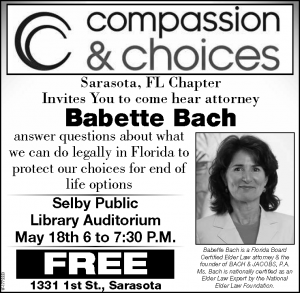
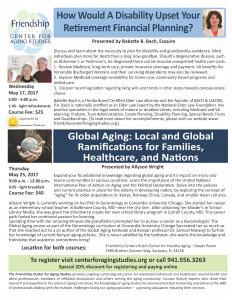
Babette Bach to speak at the Friendship Center on: “How Would A Disability Upset Your Retirement Financial Planning?”

By Asset Protection Planning, Firm News

Babette Bach will be speaking at the Friendship Center, 1888 Brother Geenen Way, event at 2:00pm on Wednesday, May 17th, 2017.  The topic is “How Would A Disability Upset Your Retirement Financial Planning?”. In this hour long program Babette will discuss the necessity to plan for disability and guardianship avoidance. Additionally, she will discuss recent legislation regarding living wills and trends in other states towards compassion choice. For more information on this event, please go to: www.friendshipcenterforagingstudies.org. and click the following link to see the flyer for this event: fcas-may-2017-bach-wright