Tag

Estate Planning

Probate Court Series: What is a Probate?

By Probate

Probate is the legal process following someone’s death that involves the payment of the decedent’s debts and the transfer of assets to beneficiaries.

The process includes:

  • Proving that the deceased’s Will is valid
  • Locating and taking inventory of all property of the deceased
  • Appraising the property once it is located
  • Ensuring that all debts and taxes are paid
  • Distributing the remaining property according to the will or as determined by the state if there is no Will.

If you have further questions, contact our office at (941) 906-1231 to schedule an appointment with one of our attorneys.

Care Planning Part 2

By Long-Term Care

While typical estate planning includes planning for incapacity during one’s lifetime as well as distribution of one’s assets upon their passing, Elder Law attorneys have an added focus of planning with long-term care in mind. If and when long term care becomes necessary, your end of life planning documents allow those you trust most to ensure you are cared for in a manner that comports with your wishes. Adding certain provisions to existing planning documents can enable those trusted persons to pursue additional planning strategies if and when the time comes for a senior to utilize long-term care. When the time comes for Medicaid pension planning, it is critical that the agent have the authority to take specific actions on behalf of the elderly person, such as establishing and funding an irrevocable trust, filing a Medicaid application, or preparing a VA pension application. The grant of authority must be clearly stated within the documents. Having clients in our office before they are in need of immediate long-term care allows our attorneys to successfully assist our clients in the most effective manner possible.

If you have further questions, contact our office at (941) 906-1231 to schedule an appointment with one of our attorneys.

Losing Capacity

By Asset Protection Planning, Estate Planning, Guardianship

It is important that while competent you decide who will make personal decisions and who will make financial decisions on your behalf should you lose capacity. Consulting with an attorney regarding your choice of agent or fiduciary will help ensure that your wishes are followed. If a person has not made these decisions and consulted with an attorney, a legal guardianship proceeding may be commenced to appoint an individual who will make decisions on a person’s behalf if the person is incapacitated.

For help regarding these matters, contact our office at (941) 906-1231 to schedule an appointment with one of our attorneys.

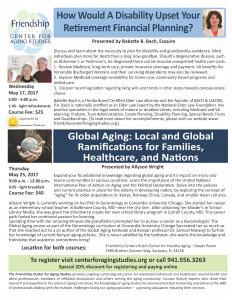
Babette Bach to speak at the Friendship Center on: “How Would A Disability Upset Your Retirement Financial Planning?”

By Asset Protection Planning, Firm News

Babette Bach will be speaking at the Friendship Center, 1888 Brother Geenen Way, event at 2:00pm on Wednesday, May 17th, 2017.  The topic is “How Would A Disability Upset Your Retirement Financial Planning?”. In this hour long program Babette will discuss the necessity to plan for disability and guardianship avoidance. Additionally, she will discuss recent legislation regarding living wills and trends in other states towards compassion choice. For more information on this event, please go to: www.friendshipcenterforagingstudies.org. and click the following link to see the flyer for this event: fcas-may-2017-bach-wright

Duties of an Agent under a Power of Attorney

By Elder Law, Estate Planning

An agent, or “attorney-in-fact,” is authorized under a power of attorney document to make decisions and undertake financial and business transactions for the person executing the power of attorney (the “principal”). An agent can fill a role and perform certain tasks authorized by the power of attorney.

An important step in fulfilling your role as agent is to follow the instructions in the power of attorney document. It is imperative that in every decision you make for the principal, whether it be medical or financial, it is in the principal’s best interest. It is a good idea to keep a detailed record of your transactions undertaken on behalf of the principal. Depending on the restrictions specified in the power of attorney, the agent typically has the authority to control the principal’s financial affairs. These authorities could include cashing checks, opening and closing bank accounts, paying bills, entering into contacts, etc.

Some principals choose to include specific authorities in their power of attorney documents. The agent can only make these actions if the document specifically authorizes them. Some examples of these powers include making a gift; changing a beneficiary designation; creating, amending or revoking an inter vivos trust; and disclaiming property.

To discuss the creation of a power of attorney as part of your estate planning or if you are an agent appointed under a power of attorney, consult with an attorney at Bach & Jacobs, P.A. that can advise you of your rights and obligations.


Estate Planning for Same-Sex Couples in Florida: Tax Filing

By Asset Protection Planning, Estate Planning, Tax Law

Because same-sex married couples are now federally recognized, they can file joint tax returns. The  IRS also recognizes federal tax provisions which include income tax credit, child tax credit, and employee benefits.

Spousal exclusion now applies to same-sex couples, which permits partners to leave property to the surviving spouse without having to pay estate taxes when the first spouse passes away.

The 2015 ruling, Obergefell v. Hodges, also made amends to states’ intestacy statutes. Now if a same-sex spouse dies without making a will, the surviving same-sex spouse will inherit some of the assets of the deceased spouse and receive other benefits formerly only available to heterosexual couples such as homestead protection.

Questions to ask before retirement

By Asset Protection Planning, Estate Planning, Government Benefits, Long-Term Care

For many seniors, retirement is a time of relaxation and having opportunities to explore their interests and the world. But before making the transition into retirement, there are some questions that you and your spouse should discuss.


  • What is the best time for my retirement? There are several factors you and your loved ones should consider before making the decision to retire. A large topic to discuss is how best to maximize your Social Security spousal benefits. You should also assess your family’s financial needs and consider the ways in which your retirement could impact your loved ones.
  • What lifestyle do I want to pursue? Everyone has a different vision for retirement. While some wish to travel the world, others plan to stay close to home. By having an idea of your lifestyle, you can properly prepare for your retirement.
  • How do I plan for long-term care? Planning for long-term care can be a long process. It is a good idea to meet with an elder law attorney to properly construct a plan. Planning ahead can save time and money and reduce unnecessary stress. Planning for long-term care involves setting up end-of-life documents, finding the right assisted living facility if necessary, and getting the best healthcare coverage for your needs.


If you wish to set up estate planning documents or plan for your retirement and end-of-life decision-making, please contact our office at (941) 906-1231 to speak with one of our attorneys.


What is a Pooled Trust?

By Asset Protection Planning, Government Benefits, Medicaid Planning

A first-party supplemental needs trust is created to allow disabled persons to receive the benefit of their funds in a trust while still qualifying for and receiving government benefits. An alternative to this trust is a pooled trust. A pooled trust is created by a non-profit organization, and individual beneficiaries can create accounts within the trust.

By pooling the assets of disabled persons, the organization can manage one master trust and maximize the benefits for the beneficiaries. The non-profit can make more stable investments and provide more services than a normal supplemental needs trust.

Most people with special needs join a pooled trust when they do not have anyone to create a first-party supplemental needs trust for them. And just like a first-party supplemental needs trust, a pooled trust is used for people to qualify for and remain eligible to receive government benefits, such as Medicaid and SSI.

A couple advantages of a pooled trust are the low costs and the fact that the funds will be used to help others with disabilities.

If you have further questions on this topic, contact our office at (941) 906-1231 to schedule an appointment with one of our attorneys.

Estate Planning for Same-Sex Couples in Florida

By Asset Protection Planning, Estate Planning, Government Benefits, Tax Law

 The U.S. Supreme Court rulings in the 2013 Windsor v. U.S. and the 2015 Obergefell v. Hodges cases resulted in changes for same-sex couples in areas such as estate planning and tax filing.

It is important that same-sex couples living in Florida take the proper steps in their estate planning, and specify key details that will ensure their protection under the law.  Such planning may include creating estate planning documents such as a last will and testament, or Revocable Trust, durable power of attorney, living will, and a designation of pre-need guardian.