A reverse mortgage is a financial agreement in which a homeowner abdicates equity in their home in return for payment. This is a tool designed to be utilized by older individuals in order to supplement their retirement income. With a reverse mortgage agreement, the bank pays the homeowner based on the percentage of accumulated equity they have in the home. This amount has to be repaid either when the homeowner dies, sells the home, or moves out permanently. To be eligible for a reverse mortgage, you must either own your home outright or have a low mortgage balance. Additionally, there are no restrictions dictating how the money received from a reverse mortgage can be used by the homeowner.
As of May 2017, the Florida Senate has voted to put a proposal on next year’s ballot that will increase the Florida homestead property tax exemption from its current value of $50,000 to a value of $75,000. This exemption applies to homesteads worth $100,000 or more and this new bill will give Florida voters the opportunity to lower property taxes. According to estimates regarding the effect of this legislation, it has the potential to save 4.3 million Florida residents a total of $644 million and the average home owner would save approximately $170 annually.
If 60% of voters approve this legislation, this new exemption rate will take effect on the first of January in 2019. Though this bill has its fair share of opponents and supporters, it will now be up to Florida voters to decide if cutting property taxes is the right decision for the state.
The Florida homestead exemption is an asset protection tool implemented to protect homestead property. Your Florida homestead will be designated to procure certain exemptions from real estate taxes.
In order for you home to be considered your “homestead” in Florida, you must have a legal title to the home, the home must be your permanent residence and you must apply for the homestead exemption at the property appraiser’s office in the county where your home is located. A second home or property cannot be considered a homestead in Florida and properties that are titled in the name of irrevocable trusts, limited liability corporation companies, corporations or partnerships are also unable to qualify as homestead properties. However, property owned by a living trust or a land trust may qualify as homestead property in certain situations.
Currently, the Florida homestead exemption reduces the value of a home for assessment of property taxes by $50,000 for homes that are worth $100,000 or more. This means that, if a home is worth $100,000, it will be taxed as if it is only worth $50,000.
Babette B. Bach, Esq. received the Lifetime Achievement Award from the Florida Bar Elder Law Section during the Florida Bar’s annual convention in Orlando on June 15. Babette was presented with the award by current chair Collette Small and past chair Emma Hemness, who gave a personal introduction. In her acceptance speech, Babette spoke about the importance of having a progressive management style that inspires loyalty from staff and clients. Babette’s family and law firm staff were in attendance for the award ceremony in Orlando. Babette is a Florida Bar Board Certified Elder Lawyer and a Certified Elder Law Expert by the National Elder Law Foundation. Babette was the Chair of the Florida Bar Elder Law Section from 2009 to 2010 and the Chair of the Sarasota County Bar Association’s Estate Planning and Probate Section from 2016-2017. She is the founder of Bach, Jacobs, & Byrne, P.A. in Sarasota.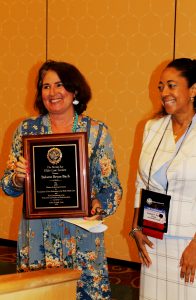

Individuals who are afflicted with Alzheimer’s disease may experience aggression related to their condition. This aggression generally surfaces in the later stages of Alzheimer’s and, while the exact reason for it is unclear, researchers believe it may be symptomatic or due to the frustration and confusion Alzheimer’s patients feel. If a loved one has Alzheimer’s and is beginning to develop aggressive tendencies, it may be difficult to figure out how to handle the outbursts and agitation.
Here is a list of tips to help handle aggressive behaviors in an Alzheimer’s patient:
Remember that what is happening is not their fault and avoid becoming angry
An Alzheimer’s patient may not be able to control their aggression, so do your best not to get angry if they lash out at you. This will only make the situation worse and will likely increase their agitation. Try to remember that what they are experiencing is not in their control and that what they may say or do when angry has no relation to who they truly are.
Learn which situations bring about anger or aggression.
If you are able to recognize which types of situations make your loved one angry or upset, it is easier to avoid them and to decrease these incidences of anger and aggression. If you are having trouble identifying which situations trigger their anger, keep a journal chronicling times that they become notably agitated or frustrated and look for patterns.
Help your loved one participate in a relaxing activity or a hobby they enjoy.
By participating in a relaxing activity with your loved one or a familiar hobby that they enjoy, it will calm both of you down and help to reduce your loved one’s confusion. Additionally, it will increase the amount of time that you spend bonding with your loved one and create memories that you will be able to treasure for years to come.
Limit the amount of loud noises and distractions.
Alzheimer’s patients tend to become frustrated by loud noise as well as the occurrence of too many activities going on around them at once. By limiting loud noises and distractions, you can reduce their confusion and agitation while increasing their feelings of peacefulness and control.
Don’t challenge your loved one.
People who suffer from Alzheimer’s tend to become confused and forget or mix up certain information. If your loved one makes a statement that you believe to be incorrect, don’t feel the need to always challenge them on it. This will likely not accomplish much and may only upset them further. If you feel that they are getting information mixed up that isn’t of much importance, it’s not usually necessary to correct them. If the information they are confusing is important, try to notify them of this in a gentle and non-threatening manner.
Today is World Elder Abuse Awareness Day. In Florida, with the growing senior population, elder abuse is an extremely prevalent social issue. Elder abuse can manifest itself in many forms, including but not limited to: physical abuse, emotional abuse, sexual abuse, exploitation, negligence and abandonment. Approximately 1 out of every 10 Americans over 60 has experienced a form of elder abuse, while only 1 out of every 14 cases of elder abuse is reported. Elderly individuals who have been mistreated have a 300% higher risk of death compared to seniors who have not been abused. Elder abuse can be prevented by educating seniors, health professionals, caregivers and families across the nation about this issue.
If you suspect or know of any elder abuse that is occurring, report it immediately to the Florida Abuse Hotline, which receives reports 24 hours a day. You can also call 1-800-962-2873 or visit https://reportabuse.com.dcf.state.fl.us and file a report online.
A Roth IRA is a retirement savings account that is funded with earnings that have already been taxed. The earnings placed in a Roth IRA are, therefore, allowed to grow without being taxed further. This type of account allows an individual to set aside a specified amount of their after-tax income each year, while keeping it from being taxed further while it remains in the account. Additionally, when these funds are withdrawn upon retirement, you do not have to pay any taxes. You can contribute to a Roth IRA at any age, as long as you have earned income from a job. It makes the most sense to open a Roth IRA if you expect your tax rate to be higher by the time you retire than it is currently. The attorneys at Bach & Jacobs, P.A. have been trained with regard to the transfer of retirement accounts at death and can advise you about this, both in planning your estate and administering a probate or trust after the account holder has died.
A qualified domestic trust (QDOT) is a marital trust utilized for the benefit of a spouse that is not a U.S. citizen. This type of trust allows a non-U.S. citizen who is married to a U.S. citizen to qualify for the unlimited marital deduction, which keeps the estate from being subject to federal income taxes upon the death of the first spouse. Without a QDOT, these estate taxes would have to be paid at the first death. With a QDOT, however, the taxes are delayed until the surviving spouse passes. This is an estate planning tool implemented to allow the assets within the trust to provide for the non-citizen spouse after the citizen-spouse has passed away, without being heavily taxed first. If you are married to a non-U.S. citizen, Bach & Jacobs, P.A. attorneys can discuss a QDOT with you as part of your estate planning.
A payable-on-death account is a bank account that is titled to the original owner but that directs distribution of its funds to a beneficiary upon the owner’s death. As long as the creator of the account is alive, the beneficiary of the account has no access to the funds within it. This way, if someone ever needs the money in the account or changes their mind, they can spend the money, choose a different beneficiary or close the account. Individuals often opt for payable-on-death accounts because they are fairly easy to create, there is no limit on the amount you can leave to the beneficiary of the account, it is free to designate a beneficiary and it allows the asset to transfer to the designated beneficiary at the account holder’s death without first going through probate court.
In Florida, summers tend to get very hot and it is important to understand the health risks associated with excessive heat. Older adults are more susceptible to hyperthermia as well as other heat-related illnesses, especially if they have preexisting medical conditions. On that note, here are five tips for staying safe as it heats up this summer:
Stay Hydrated.
- While this tip seems like a no-brainer, it is easier to become dehydrated than you may think. To stay hydrated during the summer, especially if you have a busy schedule, carry around a refillable water bottle and continually drink from it throughout the day. To be on the safe side, set a goal of drinking 8 glasses of water each day. Not only does water have a myriad of health benefits, it also helps keep you from becoming overheated or otherwise ill due to the weather.
Check the Weather Before Going Outside .
- Remember to check the weather before you venture out for the day. If it is extremely hot, stay home and turn your air conditioning on or, if you don’t have air conditioning, go to a venue that does. Additionally, avoid participating in activities that involve being outside for extended periods of time. If you have to go to an outdoor event, take it easy, as physical exertion can cause dehydration and heat stroke.
Be Aware of Your Medications Possible Side Effects.
- Some medications can cause weakness, faintness, dizziness or reduced sweating. All of these factors can amplify the negative effects that heat has on an individual’s body, and may increase your risk of becoming afflicted with a dangerous heat-related condition.
Don’t overdress.
- Though your regular daily outfit may consist of a sweater and long pants, during summer it is important that you dress according to the weather. When possible, wear shorts or t-shirts and avoid bulky or thick clothing items. This will help keep your body temperature down and reduce the likelihood that heat will negatively affect you.
Participate in Activities That Keep You Cool.
- During summertime, fun activities that can help you beat the heat include swimming, seeing a movie, visiting friends or family members at their homes, going out to eat at an indoor restaurant and shopping. Not only are these activities entertaining and give you something to do, but they can also keep you from becoming subjected to any heat related illnesses or ailments.