Tag

Asset Protection Planning

Babette Bach Esq. Will Be a Guest Speaker at Event on March 31st, 2017

By Firm News, Health

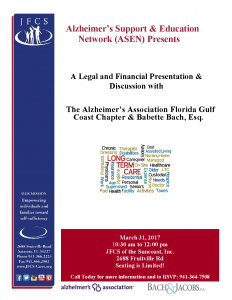
Attorney Babette Bach, Esq. will be a keynote speaker at an event at JFCS of the Suncoast entitled “A Legal & Financial Presentation & Discussion with The Alzheimer’s Association & Babette Bach, Esq”. This event will take place on March 31st, 2017 from 10:30am to 12:00pm and is presented by the Alzheimer’s Support & Education Network. Please see the event flyer and call 941-364-7508 for more information.

caregiver-education-march-2017


How do I find unclaimed property?

By Asset Protection Planning, Estate Planning

Companies and financial institutions are required under law to returns the money from abandoned accounts to the state of the owner’s last address.

To find missing funds, you could begin your search at http://www.missingmoney.com/ which is endorsed by the National Association of Property Administrators. Some companies and institutions also assist you in finding your property for a percentage of the value they help recover.

However, some of these offers are not always legitimate. In Florida, the state’s unclaimed property administrator gives a free online search at to https://www.fltreasurehunt.org/. Contact our office at (941) 906-1231 meet with an attorney regarding the transfer of your deceased loved one’s assets and to ensure that your lost property search is conducted properly.

What is unclaimed property?

By Asset Protection Planning, Estate Planning

Unclaimed properties are the assets in accounts that have remained inactive for more than a year. This unclaimed property includes assets in checking and savings accounts, stocks, dividends, trust distributions and more.

The financial institutions where these accounts are located are required under state law to return these accounts to the state’s unclaimed property administrator. In Florida, if the rightful owner never makes a claim for the assets being held by the administrator, then the unclaimed property goes into the State School Fund for public education. The process of claiming property is simple and at no cost.

Assisting in the search for unclaimed property is part of the services that Bach & Jacobs, P.A. provide to personal representatives, trustees, and families of those who have passed away. Bach & Jacobs is a full services probate and trust firm that can assist you in recovering any unclaimed assets titled in the name of your deceased loved one.

Big Improvements Coming To Florida’s Medicaid Long-Term Care Program

By Long-Term Care, Medicaid Planning

I’m thrilled to report a landmark settlement which will improve the quality and quantity of home care services for Medicaid enrollees receiving home and community based services. Congratulations to attorney Nancy Wright of Gainesville, Florida (lead Counsel), Disability Rights Florida and Southern Legal Counsel.

Under the Settlement Agreement, health plans that administer Medicaid long-term care services will be “required to provide an array of home and community-based services that enable enrollees to live in the community and to avoid institutionalization”.

The Settlement Agreement also states, among other things, that AHCA will:

  • Adopt rules that set out requirements for coverage of long-term care services
  • Require a new assessment procedure that takes into account the availability, willingness and ability of voluntary caregivers.
  • Amend their contract with health plans to ensure compliance with these rules
  • Require changes to health plan member handbooks to clarify enrollee rights and how to file consumer complaints
  • Train (or re-train) health plans, hearing officers, AHCA staff and others on the new requirements
  • Monitor case managers on how assessments are being done
  • Use enrollee surveys that ask about sufficiency of services

The agreement impacts all six health plans now operating in Florida to provide Medicaid services through the Long-Term Care Program: Coventry/Aetna, Humana, Sunshine Health, Molina, United Healthcare and Amerigroup.

Should you have any questions regarding this topic or any other Medicaid related enquiry, please contact our office on 941-906-1231 to schedule an appointment to meet with one of our attorneys.

What property does not go into a living trust?

By Asset Protection Planning, Estate Planning

While it is common for people to put valuable assets in their living trusts, there is a long list of property that is usually excluded from trusts.


Property of Little Value

Property of little value may not need to go through probate, so it typically does not need to be included in a trust.


Property You Frequently Buy or Sell

If you don’t expect to own the property at your death, do not put it in your trust.


Cars

If your car is of little value, as most cars are, it makes sense not to transfer ownership to your living trust. Some lenders and insurance companies are hesitant to insure a car owned by a trust. This could become a confusing and burdensome problem. However, if you consider the vehicle to be a valuable antique, or if it is a mobile home attached to land, you may want to include it in your trust and transfer the ownership to the trust.


Life Insurance

The proceeds of your life insurance are distributed according to your policy and do not go through probate. Thus, you do not need to name your trust as the beneficiary of your life insurance policy.


Personal Checking Accounts

Because money moves in and out of these accounts so frequently, they are typically left out of living trusts.


IRAs, 401(k)s

Retirement accounts cannot be owned by a trust. However, you can always name a trust as a beneficiary or designate a beneficiary in the account documents to receive the assets when you pass away.


Cash

While there’s no way to transfer tangible cash to a living trust, you can transfer ownership of a cash account to a living trust. By designating a beneficiary, that individual will receive the remainder of those accounts. Once you put money in a bank account, transfer it to yourself as trustee and name the individual in the trust document as the beneficiary.
How Does Remarriage Affect Estate Planning?

By Estate Planning

As our society has increasingly high divorce and remarriage rates, more individuals are faced with the task of updating or revising their Estate Planning documents to account for their change in partner. However, remarriage can make Estate Planning quite complicated, especially if each or either spouse has children by a previous partner.

The first step in updating your estate plan if you plan on getting remarried is to review yours and have your current partner review theirs. If you both decide that you would like to continue to keep your assets separate and leave everything to your respective children, then you will need to contractually agree to this by entering into a prenuptial agreement or “prenup”. At this time you may want to amend your advance health care directives and medical release forms as well.

If you have further inquiries, the skilled attorneys at Bach & Jacobs can assist you with Estate Planning. Please call our office at 941-906-1231 to schedule an appointment.

What property goes into a living trust?

By Asset Protection Planning, Estate Planning

Unlike a testamentary trust, which is set up in a will and takes effect after someone’s death, a living trust is established and funded during one’s lifetime. A revocable trust can also be utilized to avoid probate, if that is a priority for you.

Typically, a revocable living trust involves three parties: the grantor, the trustee(s), and the beneficiaries. It is a good idea to include your most valuable property in a living trust. Some of these assets may include your:

  • House
  • Stocks, bonds, and mutual funds
  • Jewelry
  • Antiques
  • Brokerage accounts
  • Business interests

For real estate that is jointly owned, it is important to remember that you do not need to transfer it into a trust to have the property pass outside of probate because the property will go directly to the co-owner if you die by operation of law.

What are Medicaid’s Asset Transfer Rules?

By Asset Protection Planning, Government Benefits, Medicaid Planning

Transferring one’s assets prior to applying for Medicaid can create several problems. The government does not want individuals transferring all of their assets to children and relatives in order to qualify for Medicaid. Thus, Congress has put in place rules and penalties for transferring assets.

Some transfers that are deemed inappropriate by Medicaid include refusing to take an inheritance that is left to you, adding a person’s name to an asset, selling an asset for less than its fair-market value, and purchasing non-Medicaid compliant annuities.

The penalty period is determined by dividing the amount transferred by the average private cost of a nursing home in your state, so determined by Medicaid.

When applying for Medicaid, individuals must disclose all transactions during a period of time called the “look-back period.” As of 2005, the Deficit Reduction Act increased this period from 3 to 5 years.

Recipients of financial transfers who are exempt from Medicaid penalties include a spouse, a disabled child, a trust for the benefit of a disabled child, and a trust for a disabled individual under 65. And exemptions also apply to the transfer of a home. You may transfer your home without the fear of penalties to your spouse, a child under the age of 21 who is disabled, a sibling who has lived in the home and holds an equity interest, and a “caretaker child.” A caretaker child is a child of the applicant who lived in the house for at least 2 years prior to the applicant’s nursing institutionalization and provided care for the applicant.

Please contact our office to schedule an initial consultation for any of your Medicaid Planning, Estate Planning, or Veterans Benefits needs.

Digital assets act grants personal representatives access to digital data

By Asset Protection Planning, Elder Law, Estate Planning

Senate Bill 494, also known as the Florida Fiduciary Access to Digital Assets Act, took effect July 1, 2016. The act allows fiduciaries to manage digital assets and communications in the same way one would with tangible assets.

Digital data includes emails, photos, social media content, and online account information.

The four types of fiduciaries that this bill applies to are personal representatives; guardians of minors or incapacitated persons; agents under the authority of a power of attorney; and trustees. Fiduciaries must provide evidence of their authority under Florida law.

The bill does not extend access to digital data to family members or loved ones who aren’t fiduciaries. Also, the act does not grant the fiduciaries the right to own the asset; it only allows them to access it.

By granting fiduciaries access to digital assets while you are competent, you can properly protect and plan for your assets.

Preventing financial institutions from refusing to honor POA’s

By Asset Protection Planning, Elder Law, Estate Planning

In the last blog, we discussed the issue of financial institutions refusing to honor powers of attorney and making clients sign their own institutions’ legal forms.

In order to prevent this from occurring, here are some suggested steps to take:

  • Draft your durable power of attorney with a trusted and experienced Florida elder law attorney who will prepare comprehensive documents for you.
  • Show your DPOA to your financial institution to ensure that it will accept the document in the future. Make sure to have this agreement signed and in writing. If the institution does not approve of the DPOA, go back to your attorney for assistance.
  • If the institution is difficult to work with, ask your elder law attorney to speak with them or move your assets to a new financial institution.

While it is important to have a durable power of attorney, it is also critical to take the extra steps to ensure that it will be honored at other institutions. If you have more questions on this topic or wish to prepare end-of-life documents, contact our office at (941) 906-1231 to schedule an appointment with one of our attorneys.