Unclaimed property is the money in accounts at financial companies that has had no activity for over a year. This can include money in bank accounts, refunds, payroll checks, trust distributions, stocks and dividends. The purpose of unclaimed property laws is to protect individuals by ensuring that their money is returned to them, rather than permanently remaining in accounts at financial institutions or companies. Every state has an unclaimed property website and office. You can recover unclaimed property by following the instructions on Florida’s unclaimed properties website (https://www.fltreasurehunt.org/) and filling out the proper forms.
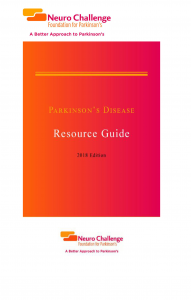
2018 Resource Guide Now Available!
The 2018 Parkinson’s Disease Resource Guide is available for download on our website: www.neurochallenge.org.
You can also request that a copy be mailed to you or a loved one by calling 941-926-6413.
The 2018 Guide provides education and information for the person with Parkinson’s, as well as the caregiver. The Guide, written by NCF’s Medical Advisory Committee, PD experts and NCF Staff, covers topics including medical treatment, non-motor aspects of Parkinson’s and practical tips on how to live well with PD today.
The 2018 Parkinson’s Disease Resource Guide is presented to you at no cost thanks to the Community Foundation of Sarasota County and The Michael Saunders and Company Foundation.
Being the Personal Representative of an Estate is a solemn responsibility. Therefore, you should choose an individual that is honest, diligent and reliable. Most people opt to designate a family member that they are close with as their Personal Representative, but if you do not believe that any of your family members are up to the task or do not want to burden them in an already difficult period, you may want to consider asking a trusted friend. However, make sure that this individual is in good health so that they will still be around and able to perform their duties by the time you pass away.
If you are not comfortable naming a friend or family member Personal Representative of your Estate, you always have the option of naming a third party Personal Representative in your Will, such as a bank, trust company, or legal professional with experience in Estate Planning.
For assistance regarding this matter, contact our office at 941- 906-1231 to schedule an appointment with one of our attorneys.
Babette Bach will be speaking at a Republican Women’s Club of Sarasota event being held tomorrow, Friday November 3rd, 2017, at Michael’s on East restaurant at 11.30am. The presentation topic will be Guardianship.

Republican Women’s Club of Sarasota
Luncheon this Friday.
MENU
1/2 portion Wild Mushroom Ravioli and 1/2 portion Cobb Salad
OR
Cobb Salad
Dessert: Mini Red Velvet Cupcakes
$27 per person, payable at door
Speaker: Babette Bach, Esq, subject: Guardianship and Elder Care
Call or email Karen at 941-306-1947 or rwcsreservations @gmail.com
A Personal Representative of a Will is the individual who is appointed to administer your estate and carry-out the wishes set forth by you in your Will. This is one of the most important decisions that you will make when preparing your Will, so it should not be taken lightly. The responsibilities of a Personal Representative include, but are not limited to: filing court papers to start the probate process, taking inventory of your estate, preparing/filing final income tax returns, distributing assets to your beneficiaries and, ultimately, notifying banks and government agencies of your passing as well as using your estate funds to pay bills.
Do you have a loved one who is disabled or has special needs? If so, then a special needs trust (also known as a supplemental needs trust) may be the right option for you and your family. A special needs trust provides your disabled loved one with financial support and is designed to supplement the benefits that a disabled person may receive from government programs. A special needs trust is used so that an individual can still qualify for and receive medical benefits and supplemental security income, without the assets in the trust being calculated as a part of their income when it comes to determining eligibility for benefits from government programs.
If you have further inquiries regarding this matter, please contact our office at: 941-906-1231 to schedule an appointment with one of our attorneys.
A living trust is a legal entity that you create with rules and conditions that apply to any assets owned by the trust. This type of trust is in operation during the lifetime of the person who establishes it and can resemble a Will in that it expresses your wishes in regards to matters such as your assets, your dependents and your heirs after death. A living trust is different than a Will because a Will only becomes effective after you die and it has been entered into probate. Living trusts are popular because they allow individuals to bypass probate, which can be a costly and time-consuming process. With a living trust, you appoint a successor trustee to transfer assets to the beneficiaries. In some circumstances, this process can take only a few weeks, while probate has the potential to last for months. Additionally, individuals concerned with privacy generally prefer a living trust, as probate records are filed in the court records and available for public inspection.
If you have further inquiries regarding living trusts or other forms of Estate Planning documents, contact our office at: 941-906-1231 to schedule an appointment with an attorney.
When you are going about Estate Planning, deciding what to do with a vacation home can seem daunting. If you decide to leave it to one (or more) of your family members, it is important that you discuss this with them. There are several choices you can consider when deciding what to do with your vacation home. If you choose an outright transfer, your home will be given to one (or several) of your loved ones as a gift, but there may be adverse tax consequences of doing so. Another option would be to place your home in an LLC made up of your family members. If you choose this method, you could have a family member manage the property and allow one or more of your family members to utilize it. You could also transfer your vacation home to a QPRT (Qualified Personal Residence Trust), in which you transfer your home to a family member in exchange for continual rent-free use for a specified term. This is a popular choice because it can reduce the amount of a gift or estate tax. Another option is gifting your home to an irrevocable trust, which would have rules regarding the use and expenses of the home among the beneficiaries.
Estate Planning comes with a large variety of options and complications. Please contact our office at: 941-906-1231 if you need assistance with your Estate Planning or have questions.
A Qualified Personal Residence Trust (QPRT) is a lifetime transfer of a personal residence in exchange for rent-free use of said residence during the trust term. When that term comes to an end, the home passes to the intended beneficiary or beneficiaries. If you are still living at the end of the specified term, you have the option to have the home distributed amongst your loved ones or put into a trust for them. This is a popular estate planning method for individuals that want to give their vacation homes to family members when they pass away because it can reduce the gift or estate tax cost that comes with transferring a residence. Both residence and vacation homes can qualify as QPRTS and often more than one home can be protected.
If you think that a Qualified Personal Residence Trust may be the right choice for you, or need assistance with any Estate Planning matters, contact our office at 941- 906-1231 to schedule an appointment with one of our attorneys.
Losing a spouse is, undoubtedly, one of the most devastating experiences a person can face and is difficult to even contemplate. However, it is important to consider and plan for the financial implications of a spouse passing before that day arrives. Then, when that unfortunate time comes, your sole focus can be on grieving and healing rather than facing financial turmoil or stress.
The first step you can take when approaching this matter is to speak with your spouse and ensure that both of you understand what assets you have (as a couple and individually), as well as where they are located. It is also important to discuss whether or not there are life insurance policies in place, who you will each be naming as survivor beneficiaries, and whether or not either of you has a pension or retirement plan. This helps to provide you both with an understanding of what you have individually, what you have as a couple, and what each of you will have when the other passes.
The next step is to gather important documents and put them all in a secure, memorable location that you will be have easy access to if needed (ex: a locked filing cabinet in your home or a safety deposit box). Documents you may need include: each spouse’s Will and a list of assets, all insurance policies, social security numbers, your marriage certificate, your children’s birth certificates, titles on vehicles as well as properties, and any relevant Estate Planning documents.
If you need assistance with the creation and development of Estate Planning documents or if you have questions, the skilled attorneys at Bach & Jacobs are experienced in Estate Planning. For help regarding these matters, contact our office at 941- 906-1231 to schedule an appointment with one of our attorneys.