
Tag

dementia

Managing Dementia’s Side Effects with Essential Oils

By Health, Long-Term Care

Now, more than ever, many are turning to a more holistic approach to medicine. For generations, essential oils have been used to ease symptoms of depression, anxiety, and insomnia.  Some research suggests that aromatherapy and the use of essential oils may be useful in the treatment of certain symptom’s of Alzheimer’s disease and other types of dementia.

Essential oils may be inhaled, applied to the skin, or ingested depending on the type of oil and its level of concentration. It is important to note that although essential oils have been used for generations and are thought to be safe, they are not regulated by the Food and Drug Administration, so you should always consult with your doctor before using to ensure that specific oils will not have any negative reaction with medications.

Some of the essential oils that been shown to be effective in alleviating different symptoms of dementia are:

  1. Lavender

Lavender is said to be calming and able to balance strong emotions. It is also an antidepressant and useful in cases of insomnia. Use it in the evening to promote better sleep, or any time of day to promote better mood.

  1. Peppermint

Peppermint is energizing and can be used to stimulate the mind. It is best used in the morning, and can be inhaled directly, diffused in the room, used as a massage oil, or even placed in a bath.

  1. Bergamot

Bergamot can be used to relieve anxiety, agitation, mild depression, and stress. It is a mood elevating and calming oil, that can also be used to relieve insomnia. It can be placed in a bath, used as a massage oil, diffused through a room, or sprayed on clothing or linens.

  1. Rosemary

Much like peppermint, Rosemary is an uplifting oil used to stimulate the mind and body. It may help improve cognitive performance and mood. Rosemary has also been known to ease constipation, symptoms of depression, and reinvigorate the appetite.

  1. Ginger

Ginger oil is helpful for anyone struggling with digestion issues. It is commonly used to treat a loss of appetite and constipation and can help promote good eating habits. Ginger oil can be applied directly to the skin as an abdominal massage, diffused, sprayed or placed on a compress.

  1. Lemon

Lemon oil is one of the most studied and effective oils. It has been shown to help calm and relax people who are dealing with anxiety and insomnia, improve memory and ease digestion. Lemon oil can be dropped in a bath, inhaled directly, diffused, sprayed or applied directly to the skin as a massage oil.

  1. Ylang Ylang

Ylang Ylang oil can help ease depression while also promoting good sleep. This is a great oil not only for the person living with dementia, but also for caregivers struggling with restlessness and lack of sleep. Ylang Ylang is often combined with lemon oil and can be placed in a bath, inhaled, diffused, or sprayed.

What are the Activities of Daily Living?

By Asset Protection Planning, Elder Law, Health, Long-Term Care

The Activities of Daily Living are a series of basic activities performed by individuals on a daily basis which are necessary for independent living at home or in the community. There are multiple variations on the definition of the activities of daily living, but most organizations agree that there are 5 basic categories:

  1. Personal hygiene – bathing/showering, grooming, nail care and oral care
  2. Dressing – the ability to make appropriate clothing decisions and physically dress/undress oneself
  3. Eating – the ability to feed oneself, though not necessarily the capability to prepare food
  4. Maintaining continence – both the mental and physical capacity to use a restroom, including the ability to get on and off the toilet and cleaning oneself
  5. Transferring/Mobility – moving oneself from seated to standing, getting in and out of bed, and the ability to walk independently from one location to another.

COVID-19: Tips for Caregivers of Individuals with Dementia

By Elder Law, Health

There is no evidence to suggest that dementia itself increases the risk for Coronavirus, just like dementia does not increase risk for flu. However, behaviors, increased age, and common health conditions that often accompany dementia may increase risk. For example, people with dementia may forget to wash their hands or take other recommended precautions to prevent the illness. Viruses like COVID-19 or the flu may worsen cognitive impairment due to dementia.

Caregivers of individuals living with dementia should follow guidelines from the Center for Disease Control (CDC) and consider the following tips:

  • Increased confusion is often the first symptom of any illness for people living with dementia. If your loved one shows rapidly increased confusion, you should contact their health care provider for advice. Unless your loved one is experiencing a medical emergency, such as difficulty breathing or a very high fever, it is recommended that you call their health care provider instead of going directly to an emergency room. Their doctor may be able to treat them without a visit to the hospital.
  • Individuals living with dementia may need extra reminders and support to remember important hygienic practices.
    • Consider placing signs in the bathroom and elsewhere to remind your loved one to wash their hands with soap for 20 seconds.
    • Demonstrate thorough handwashing.
    • Alcohol-based hand sanitizer with at least 60% alcohol can be a quick alternative to handwashing if your loved one cannot get to a sink to wash their hands easily.
  • Ask their pharmacist of doctor about filling prescriptions for a greater number of days to reduce trips to the pharmacy.
  • Think ahead and make alternative plans for care management if the primary caregiver should become sick.

How to Stay Connected to Loved Ones in Nursing Homes During a Pandemic

By Health, Long-Term Care


Family caregivers have now faced weeks or even months of physical separation from their loved ones in nursing homes and other long-term care facilities in order to protect them from Coronavirus. The restrictions on in-person visitation in long-term care facilities during the pandemic have made it challenging for family caregivers to stay close and present in the lives of their loved ones. The lack of family contact and attention can create feelings of isolation and anxiety for a resident, and additional stress for already worried families and friends, who are used to visiting in person.

While you may be unable to visit your loved one in-person, it is possible to brighten their day and try to ease feelings of isolation. Here are some ideas for staying emotionally connected to loved ones while visitor restrictions are in place:

  • Plan a virtual visit. There are several apps that will allow you to meet with your loved one virtually, including FaceTime, Zoom, and Skype. Most facilities are more than willing to assist your loved one in dialing in to a call. Some facilities even have iPads for easier viewing.
  • Send snail mail. Cards and letters are an easy way to tell someone you are thinking of them. Write an update about routine family activities. Have your children draw a picture. Include a photo showing your quarantine activities. Receiving updates will be reassuring to your loved one that you are okay during this health crisis and will provide your loved one with a genuine connection to you.
  • Create a photo book. Create a photo book with photos of what you, family, and friends have been up to. Include captions identifying family members and friends, with a small description. It can be as simple as a few pages printed from your home printer and stapled together, a poster board assortment, or a professionally bound book from Shutterfly or another online printing company. Most facilities will accept envelopes or packages at the front desk and will have staff members deliver to your loved one’s room, or they can always be sent in the mail.
  • Have a window visit. Many facilities will schedule a specific time for your family to “meet” your loved one through a window on the ground floor. You will be on the outside, and your loved one will be safely on the inside. You can chat, share smiles and laughs, and a touch through the glass. You can make special occasions, like a birthday or holiday, extra special with handmade signs.
  • Create a phone chain. Create a schedule of different family members and friends to each call your loved one on a specific day. This is a great way to connect others also feeling isolated, especially seniors and those living alone, with your loved one. Plus, a regular daily phone call gives your loved one something to look forward to.

COVID-19: Tips for Supporting Loved Ones with Dementia Living in Nursing Homes During the Pandemic

By Elder Law, Health, Long-Term Care

There is no evidence to suggest that dementia itself increases the risk for Coronavirus, just like dementia does not increase risk for flu. However, behaviors, increased age, and common health conditions that often accompany dementia may increase risk. For example, people with dementia may forget to wash their hands or take other recommended precautions to prevent the illness. Viruses like COVID-19 or the flu may worsen cognitive impairment due to dementia.


The CDC has provided guidance on the prevention and control of COVID-19 in nursing homes. Precautions may vary based on local situations. If you have a loved one with dementia living in a nursing home:


  • Check with the facility regarding their procedures for managing COVID-19 risk. Make sure the facility has your emergency contact information and contact information for another family member or friend as backup.
  • Do not visit your loved one in the facility if you have been exposed to COVID-19, or have any signs or symptoms of illness.
  • Depending on the situation in your local area, facilities may limit or not allow visitors, in order to protect the residents.
  • If visitation is not allowed, ask the facility how you can have contact with your loved one. Options may include telephone calls, video chats, or emails to check in.
  • If your loved one is unable to engage in calls or video chats, ask the facility how you can keep in touch with staff in order to get updates.

Elder Exploitation – Fla. Stat. §825.1035 – What is considered “Exploitation”?

By Elder Law

On July 1, 2018, a new Florida statute, §825.1035, Fla. Stat., created a new legal process to protect vulnerable adults from exploitation. Exploitation is defined in §825.103(1), Fla. Stat., and includes:

  1. Using or trying to use a vulnerable adults funds or property with the intent to deprive the vulnerable adult of it, or to benefit someone else, by a person who is in a position of trust and confidence with the vulnerable adult, or by a person who has a business relationship with the vulnerable adult.
  2. Using or trying to use a vulnerable adult’s funds or property with the intent to deprive the vulnerable adult of it, or to benefit someone else, by a person who knew or should have known that the vulnerable adult lacks the capacity to consent.
  3. Breaching a fiduciary duty to a vulnerable adult by the vulnerable adult’s guardian, trustee, or agent under a power of attorney, which results in an unauthorized appropriation, sale, or transfer of property; or if the fiduciary violates the following duties:
    1. Fraud in appointment;
    2. Abuse of power;
    3. Wasting, embezzling or intentionally mismanaging assets;
    4. Acting contrary to the vulnerable adult’s sole benefit or best interests.
  4. Misappropriating, misusing, or transferring without authorization, funds from a bank account where the vulnerable adult was the sole contributor or payee of the funds. This applies only to personal accounts, joint accounts created with the intent that the vulnerable adult has all rights to the money deposited, or convenience accounts in accordance with §655.80, Fla. Stat.
  5. Intentionally or negligently failing to effectively use the vulnerable adult’s income and assets for the vulnerable adult’s support and maintenance by a caregiver or a person who stands in a position of trust and confidence.

If you believe that a Florida senior may be the victim of financial exploitation, contact the attorneys at Bach, Jacobs & Byrne, P.A. to discuss your options and legal remedies to end the abuse. Call (941) 906-1231 to schedule an appointment.

Can an individual with dementia be found to have sufficient capacity to execute a Will?

By Estate Planning, Probate

Yes, it is possible that a person with dementia may be found to have testamentary capacity, depending on the circumstances surrounding the execution of the Will. Indeed, Florida law presumes that the testator of a Will had the capacity to execute the Will, and it is therefore the burden of any contestant of the Will to prove that the testator was not of sound mind when creating the Will.

Generally, the standard in Florida for testamentary capacity to make a Will or trust is not exactly the same as incapacity in the guardianship context. The case In re Bailey’s Estate defines “sound mind” as, “the ability of the testator `to mentally understand in a general way the nature and extent of the property to be disposed of, and the testator’s relation to those who would naturally claim a substantial benefit from the Will, as well as a general understanding of the practical effect of the Will as executed.” Because individuals suffering from dementia may have periods of lucidity (also known as a “lucid interval”), courts have found that such individuals can be possessing of sound mind at the time when they make their Wills. It is important to note that the only point at which the testator of a Will has to be of sound mind in order to validly execute a Will is the moment at which they create the Will.

Certainly, the validity of a Will made by a person with dementia can be challenged. If the court finds that the testator was diminished in capacity at the time of the Will’s execution, the Will can be invalidated. In addition to estate planning and administering probates and trusts, the attorneys at Bach, Jacobs & Byrne, P.A. are trusted estate litigators who represent clients in challenging (and defending) testamentary documents after the testator’s death.

Warning Signs of Dementia

By Health

Dementia is defined as a chronic or persistent disorder of the mental processes caused by brain disease or injury. Dementia is traditionally marked by symptoms such as memory disorder, personality changes and impaired reasoning. Dementia is a very complex and progressive condition, with negative effects that can manifest themselves as a variety of different symptoms.

To help you be able to identify the possible emergence of dementia in an individual, here’s a list of warnings signs and symptoms:

  • Memory loss
  • Communication impairment
  • Impaired visual perception
  • Repetition in conversation or in daily activities
  • Confusion
  • Mood swings
  • Inability to perform tasks that they are usually able to complete in an adept manner
  • Apathy
  • Frequent falls

If a loved one is experiencing any of these symptoms or you think that they make be suffering from an affliction such as dementia, schedule an appointment with their doctor immediately and get their condition diagnosed and treated.

Reducing the Risk of Dementia

By Health

A new international study featured in the Lancet has released nine factors that contribute to the risk of dementia. This study was recently presented at the Alzheimer’s Association International Conference in London and suggests that lifestyle changes can aid in the prevention of dementia.

The scientists who presented this study suggest that these nine preventable factors (listed below along with the percentage of the risk they cause) make-up 35% of dementia risk in individuals and states that behavioral changes can help reduce or eliminate this percentage of risk.

  1. Mid-life hearing loss (9%)
  2. Failing to complete secondary education (8%)
  3. Smoking (5%)
  4. Failing to seek early treatment for depression (4%)
  5. Physical activity (3%)
  6. Social isolation (2%)
  7. High blood pressure (2%)
  8. Obesity (1%)
  9. Type 2 diabetes (1%)

These nine factors, which are considered to be modifiable, can contribute to the risk of developing dementia. The other 65% of dementia risk is thought to be non-modifiable, so making lifestyle changes that help an individual avoid from falling into any of these above categories may be one of the only ways to decrease the risk of developing dementia.

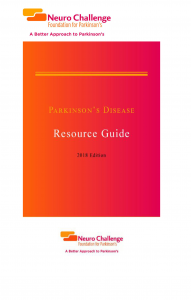
Now Available – Neuro Challenge 2018 Resource Guide

By Health

2018 Resource Guide Now Available!

The 2018 Parkinson’s Disease Resource Guide is available for download on our website: www.neurochallenge.org.

You can also request that a copy be mailed to you or a loved one by calling 941-926-6413.

The 2018 Guide provides education and information for the person with Parkinson’s, as well as the caregiver. The Guide, written by NCF’s Medical Advisory Committee, PD experts and NCF Staff, covers topics including medical treatment, non-motor aspects of Parkinson’s and practical tips on how to live well with PD today.

The 2018 Parkinson’s Disease Resource Guide is presented to you at no cost thanks to the Community Foundation of Sarasota County and The Michael Saunders and Company Foundation.